Sunday, July 31, 2016

I will not picket!!!


I understand that sometime in the next 24 hours we are to picket in protest of our brother Mutiso’s sacking from his position as the Village Director. This protest is supposed to push the administration to invert their decision and reinstate our brother to his previous position. I refuse to picket for a number of reasons.

The Whys.
I do not have the details of the reasons for the dismissal, but I do believe that the SOS organization is not an “at will” employer, and thus will need to have good cause to fire an employee. Whatever the reasons for letting him go must be well documented and correct procedures followed. We do not need a protest to get to the bottom of it. The aggrieved party has the ability to state their grievances and a solution can be found. We all know how notorious SOS is at keeping records for everything, so somewhere there is a document stating the reasons for the dismissal. On the other hand, Mutiso has not stated his position in the matter so we can only presume that he is consenting to the actions being carried out in his name. Silence means consent and all that.

Double standards
Are we saying that ex-SOS children who choose to work for the organization be handled with kid gloves? We did demand that institutional corruption be handled. If anyone in the organization is found to be engaging in any unfavorable activities, they should be let go. Notwithstanding if they are ex-SOS children employees (personally I hold them to a higher standard with the expectation that they being beneficiaries of SOS should know better). I will reiterate my point of SOS the organization and SOS the home as different entities. Dismissal from the organization does not mean dismissal in the social setting. If anything, families are pulled together in times of adversity. We may not like that our brother was sacked as a family, but that does not rule out the fact that he was found wanting at the organization level.

Leadership
I have no faith in the organizers of the protest. I believe there is a lack of transparency in their actions and most of all a hidden agenda in their activities in general. How was this decision to hit the streets made? Is there a general consensus that this is the right path to take? Why the refusal to use the proper channels to resolve the issue? Who is financing the activity? I suppose if we follow the money we can reveal the masterminds and in the process know what the real agenda is. The problem with assumed leadership is that the loudest entities believe that they represent the masses. Unfortunately, the voice of reason always gets heard eventually. After all it only took one small kid to convince everyone that the emperor had no clothes. We need to change up things, we need to choose paths that make sense and not means to an end for some people’s agendas.

Transparency (or lack thereof)
I also understand the in-depth information on the matter was only imparted to a particular clique, and not everyone expected to show up for the demonstration. We have progressively built groups within groups among ourselves; we have also insulted each other and engaged in breaking each other down. All these contrary to the message we try to portray, that we are one big family. How do you convince people you pushed away to join in your activities and present a united front? Do not be selective of what activities I am able to participate in as a family member. We all need each other as a family, but I believe if you want my brawn, you cannot separate it from the brain. You have to give me the information I need to make the decision whether I will picket or not. Without which I will not avail myself to further your agenda.

Ethics
The success of SOS as an organization depends on a careful balance of diplomacy and social engagement with our stakeholders. There is a reason why PR activities are delegated to professionals. We need donations to run this ship and donors need to see the effects their contributions make. Why cut of your nose to spite your face? We cannot afford bad publicity. Why do we claim to be fighting for the future of SOS and dragging SOS through the mud at the same time? If anything we should have ourselves to blame for any fallout after this. Now, can someone tell me who should be saved first from a burning building; an old man, or an infant? Are we ready to jeopardize the futures of our brothers and sisters in the village to save one person’s job. And who was that smart person who decided that we should use a hammer to kill a fly anyway?

So my brothers and sisters, until all my questions are answered, I will borrow a leaf from Baba Lupita, I will keep to the sidelines and watch the demonstration while drinking my hot chai.


Wednesday, March 25, 2015

WHO ARE WE?

This post is a reply to a request by one of our brothers to explain what SOBGA is and also to address another brother’s comment below.

“Where and what are other SOGBA members doing to save SOS? Ever since it was formed,only one member is active and we do appreciate. Are the rest waiting for someone to die, may the good Lord forbid, so they can call their 'family members ' for the Ksh 5000 house contribution? SOGBA representatived,you either save your home or break the group!!! 16 Houses and only ONE member is active!!!!! Be real SOGBA!”

-Fredrick Orinda

I will first thank you all for taking your time to engage in this discussion. I believe in the exchange of ideas and opinions. I have to also apologize for being remiss in our duties as older generations of SOS youth to educate our younger brothers and sisters on the paths we have taken before that they may be taking at the moment. This question should not have been asked if that duty had been done.

So, what is SOBGA?

SOBGA is the acronym for SOS Old Boys and Girls Association.

Who are the members?

I believe membership is by virtue of being a former SOS youth within the Kenyan villages where the association is based. I believe this one qualifier makes us all former SOS youth members. So SOBGA is you and me. We are SOBGA.

SOBGA was formed to address different issues that we face as former SOS youth. One of the main purposes was to work as a united front instead of resorting to anonymous letters to the administration when issues arise. There was also need for protection from persecution of members for whistle blowing. For example, our Brother Isaac’s recent attempted arrest. Thanks Izzo for your endeavors in bringing issues to light.

Essentially, SOBGA was to act as the bridge between SOS the organization and SOS the community. These two entities have to work together for progress to happen. The fact of the matter is that we both need to coexist, that is the reason we need moderation and tact in handling our issues. You cannot cut off your nose to spite your face. We have younger brothers and sisters still in the system that we need to think of. Their very survival depends on it.

I believe your first question has been answered Orinda, since we do have different SOS children and youth at different levels trying to affect change. Change is not always a result of visible actions. Wind can effect a change as destructive as water and yet it is not visible to the eye. Let’s not squabble over who seems more active. We need to have a unity of purpose. Our business is to see that things are running as they should be in our home.

Your reference to the contributions we make during funerals is what elicited an apology from me. Before this arrangement funerals for our brothers and sisters were riddled with financial challenges. You were obviously too young at the time to feel the weight of the inability to fulfill a brother’s last rites of passage. This present arrangement is the solution that seems to have worked so far. What part of this arrangement irks you the most? How do you suggest we should change it? If you have another solution we are willing to hear you out.

Now that we have established that we former SOS youth are all representative of that entity SOBGA let us all show some unity of purpose and stop pulling each other down like crabs in a pot. Let us also engage with each other and find workable solutions to our problems.


Monday, March 23, 2015

It saddens me to make this post today. The cause of my consternation is that if all the claims I put forth are true, then we as SOS have diverged so far from our founder’s dream and vision; that we should find ourselves a different name. A quote that comes to mind is:

 "Men, like nails, lose their usefulness when they lose direction and begin to bend."
Walter Savage Landor

Are we as an organization losing our usefulness? 

The SOS vision states that, “Every child belongs to a family and grows with love, respect and security.” Sounds simple yes, but it seems the people on the ground have become increasingly confused by its meaning. One thing we need to keep in mind is that as an organization, we are major contributors in the creation of policies related to children so we cannot preach what we do not practice. Our organization should be at the forefront in the fight for children’s basic rights. We should not be the perpetrators of abuse of the children directly through our employees, or indirectly through our policies.

Rampant misappropriation of funds
Food is one of the basic rights that we as an organization have the ability to protect, and should be protecting. Unfortunately, this is one of the areas we are failing miserably. Funds for food are received two week into the month; and in some cases three weeks into the month. Apart from food being a basic right, shouldn't we have in place a mechanism for disbursing funds with minimal cash handling to deter mismanagement of funds?  If an item was on the budget to begin with, why is the money being diverted, or withheld? Is it a policy for our organization to replace funds for food with donations? If this is the case who decides on the monetary value on the donation and what is done with the diverted funds?

Sexual Abuse
Given the nature of our business, we should have zero tolerance on sexual abuse. We need to be non-negotiable in cases involving sexual abuse because our vision expects us to provide security to the children. The major reason to have such a policy is because there is a huge potential for “Quid pro Quo”harassment, that is sexual favors in exchange for benefits. We have seen cases of administrators who had sex relations with all and sundry, youth and mothers included.  Such a situation is highly unethical and a health hazard; in some courts such an individual can be charged with felonious assault, especially if a disease was spread in the act.

Conflict of interest
It is wrong for our employees to use SOS as the main market for their business activities, especially so, if they happen to be the same party directly involved in the sourcing of the services. For example, a PR manager sourcing services from their own PR firm. Need I say more?

Nepotism
Is it true that our hiring process is hacked? If this is so, the solution is as simple as getting a new firm to do the job. From a management point of view, this is one of the reasons for low quality output, entitlement and corruption. Our processes as an organization should have enough flexibility to allow for such a change without interruption to our daily business.
Talking about our hiring process, I would wish to see the day when our National Directors present their mission for the organization upon their assumption of office. This mission should be hung up in a central place in all the projects and at the end of their term be evaluated based on it before rehire. This will encourage transparency and accountability.


In conclusion, as an organization we need to go back to the basics of our mission in child care. We need systems of accountability to be put in place at all levels of our organization. We need red tape reduced for processes that are crucial in the running of our organization. We need ethical administrators to implement our vision and all the project players need to be on the same page with regards to our goals and mission. 

Let’s all strive to remember to maintain our usefulness.

Wednesday, November 13, 2013

Survive- to continue to function or prosper. (Merriam-Webster)

Two of our own were featured this week on the Survivor Series . Watching this feature left me with a sense of pride. Asha Jamilla and Moses Kihara are truly survivors. They are using the lessons of their past to build their future. 


From a publicist point of view, this is a good piece for fundraising purposes. It highlights the problem, and presents SOS solution to the problem. I wish there was more information for potential supporters, like a number to call, or a website etc.

Our challenge now remains on how to keep these children’s momentum. Evidently they plan to succeed; so it’s up to us as the SOS community to facilitate them to that end. I have pointed out in previous blogs on how we should be mentors to our brothers and sisters, and to also take a moment and hear their dreams.

Tuesday, November 05, 2013


Things your mom knows but won’t tell you to your face

This is a short disclaimer from me before we start this discussion. The views represented here are my own and do not represent any other persons or entities. I am not receiving any favors or remuneration for the views herein. If any views out there have been represented, it is purely coincidence; maybe because they are common sense?
Recently there has been a move to address a number of issues by a section of SOS youth. While I applaud your initiative to address issues, here are some words of wisdom any of your mothers in SOS would have given to you.

While SOS is your home, it is also an organization.

Yes, SOS is the only home you know. You grew here; it is your pride and joy. It also happens to be an organization whose primary mission is to care for the orphaned and abandoned children. I believe that this is where the bone of contention lies. We who grew up her view it as a home and those who work here see it as an organization. We need to find a common ground and share the same point of view on the issues that affect us all, or we will always be at loggerheads.

Homes are more static in nature while organizations are dynamic.

The rules in your home have probably remained the same since you were a kid. Whenever you gather together nobody has to explain the rules of conduct, seniority by age is known, each individual’s character is known, etc. Organizations on the other hand are a different conundrum. They experience many changes. These could be leadership, operational, or structural to name a few.

SOS the home mostly affects our social life, SOS the organization affects all issues administrative and the two need each other.

While it is good to embrace the role community plays in our lives, we should also be aware of the hand that feeds us. You cannot spite the mouth to feed the stomach. Issues of contention should be approached with diplomacy and tact. When faced with differing opinions in a social setting, the resolution is not always about things being done your way, but rather a move to finding a middle place where there is give and take from all the dissenting parties.

A symbiotic relationship is the healthiest between the two no matter how bitter the pill is to swallow.

SOS the home is a community, not a collection within the group.

A community only stands strong by the strength of its leadership. Leadership within the group is determined by different the election of representatives among the various groups represented. We have mother reps, house reps etc who by virtue of their elections are the official representatives in all matters that affect the groups that elected them.

There may exist within the community respected members who on occasion may voice concerns which is welcome, or not by some members of the community. It is also a common understanding that the views are shared by a majority of the community members and also supported by other respected individuals in the community. Short of this the expressed concerns remain personal and one cannot purport to represent the community as a whole.

You catch more flies with honey than with vinegar.

This is self explanatory; aggression, accusations, and abusive language are like a fireworks display, loud and distracting and leave only smoke in their wake. Let us employ more tact in our discourse. A little respect to someone’s office goes a long way. The same way we expect respect accorded to our mothers and our reps is the same way we should respect the representatives of SOS the organization.

Today’s challenge
What are your responsibilities and roles in SOS the home and SOS the organization?


Friday, September 17, 2010

Are we still here?

Someone once asked me if I would be able to record my experiences and those of other youth on life after disengagement from SOS aka "maisha inje ya gate". I just smiled and did not answer. The reason being, how do we evaluate only one aspect of life when the past affects the present. To describe my experiences, I will have to go back to my past which may bring controversy. My view may be biased, or true and may affect other people who may have played different roles in my past life. My main fear of facing the past is that a lot of forgiving may have taken place but, the struggle to forget is still there. Another fear is that society's expectation is that we keep the ugly past buried and only speak of the good times.

How does one turn of society's tendency of to judge actions that may have been forgiven? And in so doing prevent the ability to purge the bad memories by speaking up? Many of us have turned judgmental in the past and taken sides when others have tried to document their past. I pray that this will change in future and speaking up will not be viewed as rebelling but as a process of improvement and hopefully reconciliation. For the ones with vested interest, not all apples in the basket are bad yet. We just hope that by removing the bad ones, the rest may be saved. So keep up your support, because for every tyrant in the community, an angel exists.

So for now, these experiences will remain undocumented, not because they have been forgotten, but because sometimes leaving no stones unturned may just result in confrontation with snakes. I will have you know that I am still looking for some snake repellent. I will document the experiences once I accomplish this mission.

Friday, January 25, 2008

Mo money, Mo Problems

I do believe that we can eat an elephant, big as it may be a bite at a time. The same applies to any problem we have. We can find a solution by breaking down the problem in bits then slowly resolve each problem at a time. At the moment, money is on most of our minds so let’s break the problem down.

We were all happy to receive the cheques and yes, we will be going out of our way to do a lot that we were unable to do previously. However before we go a-spending I would like to share a few concepts with you. One of the basic concepts of economics is;

Income – Spending = Savings

I suggest that we all do less spending to ensure that a lot of saving is done. I agree that we do have pressing needs like rent, fees, debts, and many more that need to be taken care of immediately. But please remember to step back before spending and ask yourself whether you can sleep comfortably after spending, or even be bold enough to stand up in a crowd and state loudly how that money was spent.

I did do some research to help our siblings who did get considerable amounts of money. Here are a few pointers on CDs (Certificates of Deposit) as a form of investment. This is how CDs work: When you purchase a CD, you invest a fixed sum of money for fixed period of time – six months, one year, five years, or more – and, in exchange, the issuing bank pays you interest, typically at regular intervals. When you cash in or redeem your CD, you receive the money you originally invested plus any accrued interest.

1. CDs generally have a higher interest rate that normal savings account.
2. Before getting CDs make sure you have checked out the following.

  • The interest rate- check to make sure the interest rate you discuss with the banker is the interest rate on the certificate you sign. Check to see whether the interest rate is variable or fixed. It is advisable to go with a fixed rate that way the bank doesn’t change the rate in the future. Do confirm with your banker how often and in what form they will pay you the interest on you CDs.
  • Determine how much of your money will be covered in case the bank goes under in the time your money is deposited with them.
  • Make sure that you are familiar with any fees the bank may charge in case you withdraw your CDs before their maturity date.
  • Make sure you are clear on the maturity date and determine whether it is a “single date” (the CD matures on a particular date and the bank needs you to determine what you want to do with the funds afterwards) or whether it has a “roll-over” function which means the bank automatically rolls over to a new CD.

Please read more on CDs here and ask your banker more questions since this site may have information that may not particularly apply to our banks here. Please do read this article as it may clear most questions you may have on CDs.


Thought of the day
How can we give back to our society? For it is in giving that we receive.

Wednesday, January 23, 2008

WHERE DID ALL THE MONEY GO?

How time flies. It’s a new year again with new beginnings I hope despite the political environment. I did make some resolutions in the beginning and despite the fact the first month isn’t over I have only two of them left and it’s a struggle to keep them.

Talking about resolutions, I am concerned with the recent turn of events related to our brothers and sisters change in luck with regards to personal finances. It is no secret that financial management is not one of our strong suits. My worry is that a lot of waste will be seen and regrets will result eventually. I need not say what the consequences are for bad financial management. Even small business lenders like microfinance institutions have a follow up system to ensure funds are spent appropriately. How difficult will it be to appoint people to do the follow up for the funds? Is it not possible to let the recipient name a person they feel ca guide them to ensure the funds are not wasted? I know everyone had plans on how they were to spend the monies. The question is how well do the recipients of the funds follow their spending plans that is, if he plans were actually genuine. Are there any feasibility requirements for the plans before cheques are issued?

I have a few words of advice for the recipients of the funds.

  1. Money is not a measurement of power. Having more money today doesn’t mean that you are more powerful as a person don’t go on a spending spree to show people that you can now afford buying more stuff(most of which you can probably do without).
  2. Your spending plan should be simple. Have a clear goal. Know how to achieve it. Ask advice if anything is unclear of if someone else you know has done the same thing/business (saves you from making costly mistakes you cannot afford).
  3. Remember your past spending mistakes and avoid them at all cost, do not try get-rich-quick schemes. No one ever made money overnight. Work longer and harder than you did before you got the money since you now have more to lose in case you fail.
I could go on and on about what you need to do or not but at the end of the day each one of us needs to be honest with themselves and review how they have spent such funds in the past and how they are willing to learn from that and make improvements this time.

Thought of the day

Spend wisely and encourage each other to do the same.

Monday, November 13, 2006

THE GOOD OLD DAYS

It’s been a while since I posted here but I do write once in a while it is just that they never get to be posted. Well today I thought I should get back on a lighter note and post some old photos from days past. The reason being life in SOS had some good sides and as bad as those cloudy days may seem, there were days of sunshine.

I managed to get hold of some old photos that I would like to share with all of you.

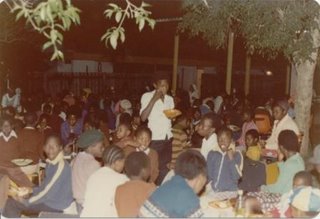
Remember the big parties we used to have around Christmas? And we would sit according to houses and share meals out in the open? Well, here is a photo to jog your memory. Gish is that you over there?


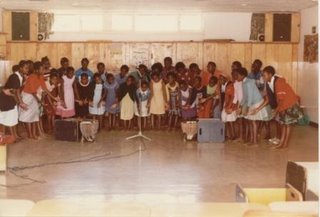
Remember how after the party we would get entertained by the village choir, (who by the way always seemed to be happy until I learned that “mangwaa” used to tell them to smile)?

Here is the choir then, I think it was that welcome song they sang for Hermann Gmeiner when he came to Kenya. Let me try and remember the words.


Karibu, karibu, karibu Kenya karibu…
As I look around
The day is clear
The air is fresh (mangwaa made the choir stress this word)
The water is cool
And whenever I walk
Be day or night…
…(can’t remember this line)…
Its beautiful

Karibu, karibu, karibu Kenya karibu……


This is as far as my power of recall can take me. But these song were always accompanies by drums (courtesy of the master drummers of the day Joe, Mbula Liz to mention a few). Thank you all for the entertainment the memories still linger.


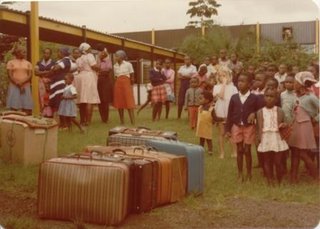
And now our worst weakness when it came to guests, collecting in crowds and staring. I cannot recall what was happening in this photo but visitors to the village were a fact of life and yet out curiosity always got the better of us.


Thought of the day
If any one can identify any or all those people in the photos please let me know.

Thursday, September 07, 2006

Mama Mia 2

Ah..hah! That question on the author’s identity again. The reason I chose not to disclose my identity is that I felt the need to separate the person from the issues being discussed in this forum. It is not for any perverse reason that I do so. Many of you will agree that as a society, we tend to read more into a situation than we should. In other words any discussion may be taken to be biased based on the family house I come from, who my friends are, etc. But I might change my mind soon and give you all a glimpse to the person behind the blog. Keep reading coz it may be soon.

On the regularity of this blog, I beg for your understanding. I will try as hard as I can and post more regularly. I also request that you all comment regularly so that I may also know what more can be discussed. ;-)

Back to our mothers

I am assuming that most of you were able to identify their mum in the photo, and were able to call them. I would like to delve further on the issue of support systems I mentioned in the previous blog. Is it possible for us as a community to carry this out? Of course we would first need to assess the situation and see how the mothers are doing at the moment. We would then need to see what worked in situations that were successful. This should not be a difficult research to carry out given the number of social workers in our midst, recently graduated youth and even youth who just completed high school. You understand that I am not talking commission of inquiry here, just a short study of the situation at hand to kick start the process.

It is important that the mothers get involved in this whole activity or else we will not see much progress. The next step will be meeting as youth, or even as a community to find out what can be done by the community to assist in this transition. As I see it, more emotional rather than financial assistance is needed. Financial assistance is another issue that needs to be addressed. I mentioned in my earlier blogs, “My Wish List” that did not have a good financial foundation in our childhood. This situation may also apply to our mothers given that most of the financial decisions are made at a different level in terms of distribution of income for use in the community. Generally, we all need to be educated about money, and how it can work for us. This is another call to all our brothers and sisters who are experts in this area to step in and educate us.

Today’s challenge
We have many professionals in our midst. I would like to ask each of you to contribute in any way you can to make our community better.

Wednesday, September 06, 2006

Mama Mia

In my last blog, I spoke about our fathers and the role they play in our lives. One reader made a comment that I overlooked the mothers' work. I did not. I just wanted to treat each of them as a different topic.

Our mothers spend the most time with us and I daresay they know us better than we do. There will be debates on why someone would leave behind their own life and become an SOS mother. In my opinion, what makes them stay is what we should wonder about. It is still a mystery to me given the challenges they face. I never quite understood how much they went through on a daily basis until I spent an afternoon minding my siblings after staying away from the village for sometime. It was a ruckus and I had a headache at the end of the day. Many mothers complain that two children are a handful, imagine having to look after ten children without a nanny, or any outside help. Now that is a major challenge.

Minding the children in their care is not the only challenge our mothers face. They also have to worry about their children when they go off to start their own lives; they also have relatives looking up to them and so many other issues they have to face in their lives. Today, an additional challenge to our mothers, just as we do when we come of age is; leaving the SOS village community and living in the community after retirement.

As of today, there is no set support strategy for the mothers when they retire. This may be because in the previous years only one mother retired at a time. This time, many mothers retired at the same time. We need to look for ways we can be of assistance to our mothers. A small task, considering what they have done for us, or the lives they had to give up to be our mums. My question for all my SOS brothers and sisters is, are we going to step in and help our mothers in their retirement? Will we join hands and seek the best solutions for our mothers to have a sustainable life after retirement, or will we leave it to one or two siblings in the family house to follow up.

Today’s challenge.


Our mothers have been our support from childhood, on their retirement we should be their support. Some experts call it reverse motherhood; I call it “kurudisha shukurani.”

Please look for your mum in this photo, call her today and tell her you love her.

Click on the photo to enlarge it

Saturday, August 12, 2006

To all our fathers

Today I would like to say a big thank you to all the fathers in our community, for being there for us and striving hard to maintain the administrative standards, and the family environment in our communities. I know it s not easy to balance the two and that is why we thank you all for your great work.

I take this opportunity to congratulate our National director Mr. Keith Castelino, on the birth of his baby boy. We are always happy to have new additions to our family.

I would also like to congratulate Mr. James Wabara on his appointment as the SOS Nairobi Village father. We will give you all our support and work with you to make SOS a better place, better still, the best place.

For a long time now I have been wondering if my point of view is biased. Today I made a discovery that has allayed my fears since another voice out there will give a balance to my perspective of life in SOS. One other voice has been raised on life in the village and it is for this reason I am happy to introduce Taata, a.k.a Mr Francis Luyera. I met Mr Luyera when I was in Uganda and this man is the epitome of what all fathers should be. Very few people leave you with the impression that what you have to say is important. He has that special way of listening to you and connecting with you as a person. It is in my opinion that SOS Kakiri is the model village and I challenge anyone to prove me wrong, and it is because of the leadership of Taata, not forgetting all the mothers and his co-workers who support the work of SOS in Kakiri. Please read more in Taata’s blog and know the man behind all that good work in SOS Kakiri.

Friday, July 21, 2006

A Word of Thanks

Back again. No post today, just a word of thank you to all who have been supporting this blog with your comments and suggestions.

Watch this blog.

Saturday, July 01, 2006

Sex Education

Today’s topic is one that I confess discomfort in discussing. Do not get me wrong, I can hold my own in a scientific exchange on the same, it is just that culture and environment created this “do not even go there” feeling around the topic. It is for this reason I will refer to the subject experts as my Communications professor says. I have included some wonderful sites with more information for anyone interested in finding out more on sex education and related issues.

1. Youth and sexuality resources on the internet

2. Resources for youth on a range of topics on sexuality including pregnancy, sexual orientation practicing safer sex and sexually transmitted infections

3. Youth work links and ideas


I can say sex education was nonexistent I my childhood, not from lack of discussions or references to any act related to sex, but from the subject’s presentation. It seemed to be discussed when there were “kangaroo cases” where some kids had gotten caught being curious (now that I know better), and showing each other parts of their bodies. The curiosity went further in some cases because I remember some cases always warranted more punishment than others.

The only time I remember sexuality issues being tackled well was once when we had some youth counselors come to the village and talk to the youth. That was the time we could ask all the questions we always wanted to ask but couldn’t ask for fear of the cane, or maybe the environment was never conducive for such discussions. How many of our sisters thanked the donators of cosmea for the relief it caused from the agony of asking for sanitary towels. It is funny how information flows freely among the SOS children and somehow never gets to the right ears. If only there was proper communication, most of the problems within the community would not have existed.

Speaking of communication, how sure are we that the children feel confident enough to report sexual abuse, or any other kind of abuse for that matter? There was a think tank project in the village a while back, what was done with the results of the survey? What was learned from those results? There was a tendency for some of the older boys in the family homes to abuse their young siblings. I know from the rumors that there was a tad of truth in the stories. Some are still affected to date and will tell you the experiences with, or even without some alcohol induced confidence.

I hope there is a program in place for sex education, not the science we learn in school. The kind of forum where questions can be asked without fear, information is imparted in a proper manner and sex is demystified enough for the children to know enough for their own safety too.

Today’s Challenge

What can you share with us on today’s topic? Your sex education as you recall, your experience in your youth etc. that can be used to benefit another?

Friday, June 30, 2006

My Wish List

How many times have we wished we could have been taught particular things in life that would have come in handy in life? Today I have made a compilation of my wish list far all that I wish I had been taught, but wasn’t, or other stuff that would have made a difference to my life.

1. Financial Management
I wish I was taught how to manage money, how to have discipline while spending that money, know where it comes from, how it is earned and maybe that would have let me appreciate it and know how to control it. Isn’t that what spending is about? Controlling where your money goes?

2. Career Development
I wish I had learnt career development, what different options were out there, how to build slowly to achieve particular career goals.

I wish I had a mentor, to give me a helping hand in my career development. To give me a model of what is needed to achieve my goal.

I wish that I could have someone actually look at my road map (not just file it) and discuss it with me. I wish we had a review together once in a while and check on my progress, or lack of.

3. School
I wish that I would have learnt good studying habits early.

I wish that study time was more than time to get together and socialize, or sit around table and play pranks on each other.

I wish that someone would have take notice of what I was actually studying in school instead of waiting for graduation day to know, or even bounce on my supposed graduation because I did not qualify to graduate.

I wish teachers could be more specific than “could do better”. Never made any sense to me, and never me gave any idea of what they wanted out of me.

I wish we also had a library membership so that I could read more books like my friends, and not have to read them during class time because they have to be taken back.
(Got into trouble with my teacher for that once)

4. Society
I wish I had learnt how to be myself and not part of the group. I wish I could have found a way of eliminating the feeling of ‘loneliness in a crowd’ earlier.

I wish someone could see me as an individual and not one of many.

I wonder what would have been different had my wish list been seen by someone who could have done something about it.

Today’s challenge
Pick any item on the wish list and change a child’s life today.

Thursday, June 29, 2006

Read On

Does anyone remember how the drawers in the Craft Center used to hold volumes of books? This was the “library” of sorts back in the days and even though the books were very old, some of the stories were still fresh. I remember one particular title “Anabella takes the plunge”. The only reason the title stuck to mind was, I learnt the meaning of the word plunge two years after reading the book. That was when I was finally taught how to use the dictionary.

I confess some ignorance on the issue of the village library’s existence; it may still exist as we speak. I know there is a reading tent activity every vacation though, but I wonder what the practice is in between. My interest in this matter was sparked after reading Ben Carson’s “THINK BIG”. I was reminded of our students (here I go again). Ben Carson’s story can be compared to what we are experiencing right now in the village. he was not doing too well in school, watching too much television, etc. His mother encouraged him to read a book a week and that opened his mind, gave him more knowledge and improved his interest in studies. I was left wondering if this is an activity that can be introduced in the villages. Have book reading contests with some small incentives to encourage reading.

I know such activities need planning and organization. No extra employees are needed. This falls under the education department I presume. So voila! We have the educator and a few of the youths assisting, and the program is off its feet. Remember how the youth used to be in charge of the chicken coup, under the supervision of the village father? I believe we have a lot of untapped talent in the youth and they will be willing to assist in the activities when called upon.

Stocking the library can be a two pronged activity. It can also be a PR activity used to inform the public on SOS work in the community.

Today’s challenge
Are you reading a book this week?

Wednesday, June 28, 2006

Of Second Chances

Thanks for the word of welcome. I would not mind an assistant seeing that I chose the hard road of endless projects. I am also afraid the next one seems to be time consuming as well. Send me an email; sobga-times@hotmail.com

I agree with you about the situation it is certainly a “catch 22” kind of scenario. Don’t get me wrong though, I am for the students going back to school. Only if they do what we sent them to do there (read yesterday’s challenge). The other problem of treating the symptoms and not the disease can be solved if we work as one unit. We are a family and every family has its head, members, rules, and points of discord; let us work through the discord together and any compromises made within this unit should not be seen as relinquishing control.

You point out in your comment that the move to bring the students back may be seen as a revolt against the administration; heaven forbid that anyone puts such ideas in their head. The fight that was won by the student was not that over power, but of chance. A second chance. A second shot at making something out of their lives. Only by realizing this will they be able to go back and do what is required, even expected of them. We on the other hand are now accountable if any of the students fail. It will definitely reflect lack of judgment on our part, and will also be used against us as a point of reference next time we lobby for an issue. The students have a tough time ahead of them; all our eyes are on them. There are high stakes on their performance. I just hope they keep this in mind and not let us all down.

Let us all work together as a family on this if we cannot agree on any other thing. Let us all take part in helping each other in any way we can. We are not experts in the game of life, but we have been where the students are. We know the challenges. For that reason, we are experts of sorts in SOS life, so lend a hand.

Today’s Challenge
Today’s challenge is for you all to respond with comments, or send me email at; sobga-times@hotmail.com

Monday, June 26, 2006

NARC (Nothing Actually Really Changed)

I am back from the land of endless projects and deadlines. I would like to send a shout out to all the graduates this year(welcome to the real world. Hope you got yourselves a pair of bata bullets for the tarmacking).
And back to today's topic. After months of meetings, discussions, and finally compromise, the students who had been removed from school will be going back. Many may see this as cause for celebration but I don’t. For some reason I fear we are in deeper than we think. Before you accuse me of being a pessimist, let me explain my reasons.

What was accomplished by bringing back the students to school? We took care of the symptoms and not the disease. The problem as we all know is that students are failing in school, as much as we may lobby to keep them there, the trend will continue and the results will be the same unless change actually takes place.

I suggest a complete overhaul of the system, let us make changes within the system that will actually attack the problem and not keep it off until the next time it rears its head. I suggest that each of the players has a role to play to assure the students success.

Students
The students have to realize that it’s a high time they took charge of their life. They should get mentors who can help them improve on their study skills; assist them in making life goals and setting priorities.

Mothers
Start early. Teach children how to study, dream big and structure their lives. Encourage the children to read at least one book a week, give them examples of people who worked hard and aimed high so that they know goals are achievable, and most of all, give them endless support and opportunities to build confidence.

Village Fathers
As the family head, you set the standards, your expectations from the children is reflected by the decisions you make, and the opportunities you present to the children in your care. And remember, your actions always speak louder than your words.

Educators
Set your priorities, you are not a disciplinarian and should not be seen as such. Your role in a student’s life is more of a councilor. You are the student’s eyes to possibilities through education so get informed of as many possibilities open to students as possible. They will thank you for it. Your belief in the student’s performance should always be positive, remember a good performance is partly a result of self confidence in a student.

Youth Leaders
Dealing with adolescents is not easy, but adolescence is the break, or make stage; you should never be limited in your views of the youths’ achievements or you will end up shattering dreams and lives. Do not play favorites; we are dealing with people’s lives here.
Today’s challenge

To all those who resumed school, please prove me wrong. Let your results say that something changed, that it was worth taking you back to school.

Wednesday, May 17, 2006

My Brother, My Neighbor: Part 2


I would wish to revisit this post because the comment posted in response made me realize that the point I was trying to make did not quite go through.

The concept of SOS is based on four principles; the SOS mother, the SOS brothers and sisters, the SOS house and the SOS village. See the SOS mission as described below on the SOS organization’s site.
Each child needs a mother, and grows up most naturally with brothers and sisters, in their own house, within a supportive village environment.

Our SOS villages are made up of a number of houses as we all know. It is for this reason that I say my neighbor is also my brother since my neighbor’s house is in fact another SOS house. So you see, my brother and my neighbor are not two different things.

I agree that within the SOS community we do not emphasis enough that we are all brothers and sisters and when we do we do not explain it well enough, or even early enough to avoid all the pitfalls that follow when the children in the village forget that they are brothers and sisters.

On the other hand, I believe actions speak louder than words. So we as the older brothers and sisters should set a good example to the younger ones and display this brother-sister concept through our actions. For example, going back to the village to solicit the young children for sexual favors is a no-no. Such a relationship should not be encouraged, or even conceived. Imagine what danger an unwilling child may be in if one older child forces their attention on them? Remember that it is very easy for the older children to move in and out of the village without raising any suspicion. In the same way, it will be very easy to even rape a child. I know this is a worst-case scenario but hey, information never killed anyone.

The question today is, will we encourage the SOS children to see each other as brothers and sisters, or will we ignore this relation and in the process become the greatest danger to those who call us and see us as their big brothers and sisters?

Friday, May 12, 2006

My Brother, My Neighbour


A comment on the previous blog on the SOS holiday program has brought up an issue I wish to discuss. There was a question within the comment on how to make the choice when one decides to host an SOS child for the vacation.

I would like to present a few questions for your reflection. Who is my brother/sister? What is the difference between a house brother/sister and a village brother/sister? What differentiates between a house brother/sister and a village brother/sister?

Personally, I do not make a distinction between the two. My reasoning being that SOS is an extended family, it extends further than the national and continental borders. The SOS philosophy on the family unit enables all mothers to regard the children as their own and from experience; I have seen that any relationship between any members of the SOS family is not based on the house, village, or even the country they come from. How else do you explain how welcome you feel in a village away from home, with a different family who still regard you as one of their own? The uniqueness of the SOS framework enables me to have a home away from home. I know that the village policy of placing guests with particular family works and goes a long way to establish a bond between the visiting SOS child, or even guest and an SOS family. Some of the village fathers go an extra mile to ensure that the visitor has some things in common with the visitor. For example, I visited a village once and I was placed with a family that had children of the same age, attending college as I was and that was exceptional service.

On the village level, I feel that each SOS child is a potential brother or sister. Let me dabble with some statistics to put my point across. Take a village like SOS Nairobi for example, where we have a total of 16 houses. If a child is brought to SOS today, the probability that the child will be placed in my family house is 1/16, a chance which will make him/her my brother or, sister. So, the only reason that any other SOS child is not my house brother/sister is purely administrative, meaning we have no control where the child is placed. I feel this is enough reason to regard and other SOS child as my brother or sister. I use the same argument to explain why marriages between SOS children from the same village should be discouraged, but that is a topic for another day.

To answer the questions that the host should play, I suggest being a mentor for the child will be the best thing to do. Guide them on making career, or personal choices. Listen to their dreams and aspirations. From experience, i think just listening goes a long way. Some of the kids have ideas already, they just need some input on how to go about it. Find more ideas in our previous posts. I am assuming that you are hosting a child who has a relationship with you. I also wish that we could pose the challenge to the village fathers, mothers and educators on what their expectations may be and perhaps we can develop a manual on how to mentor a child. I would also like to ask if anyone has suggestions on what advice, experiences etc. worked for them, or not as they were growing up in the village.